
Insulation for PEB Structures in Odisha
Keep your building cool in summer, warm in winter, and energy-efficient all year. Our Insulation Solutions — including Air Bubble, XLPE, and Sandwich Panels (PUF, PIR, Rockwool, EPS, Glasswool) — are engineered to reduce heat transfer, control condensation, and improve comfort. Delivered and installed across Odisha.
Get A Free Quotation
Introduction
Why Insulation Matters for Your PEB Building
A Pre-Engineered Building without insulation is like a car without air conditioning — it works, but it’s uncomfortable and inefficient. In Odisha’s climate, where summer temperatures soar and monsoons bring heavy humidity, proper insulation is not a luxury — it’s a necessity.
The Reality Without Insulation:
A standard industrial shed in India can reach internal temperatures of 55–65°C during peak summer
The roof accounts for approximately 40–50% of total heat gain in a PEB structure
Walls account for approximately 15–20% of heat gain
The Benefits of Proper Insulation:
Temperature Control: Brings internal temperatures down to 35–40°C — a dramatic improvement in working conditions
Energy Savings: Reduces cooling load and HVAC equipment costs
Condensation Control: Prevents moisture buildup that causes corrosion of steel members
Acoustic Comfort: Reduces noise from heavy rain and external sources
Worker Productivity: Maintains comfortable working conditions, improving efficiency
At Arise PEB Construction, we supply and install a complete range of insulation solutions for PEB structures in Odisha — from air bubble insulation to high-performance sandwich panels.
Types Of Insulation We Offer
Complete Range of PEB Insulation Solutions
A. Air Bubble Insulation
What It Is:
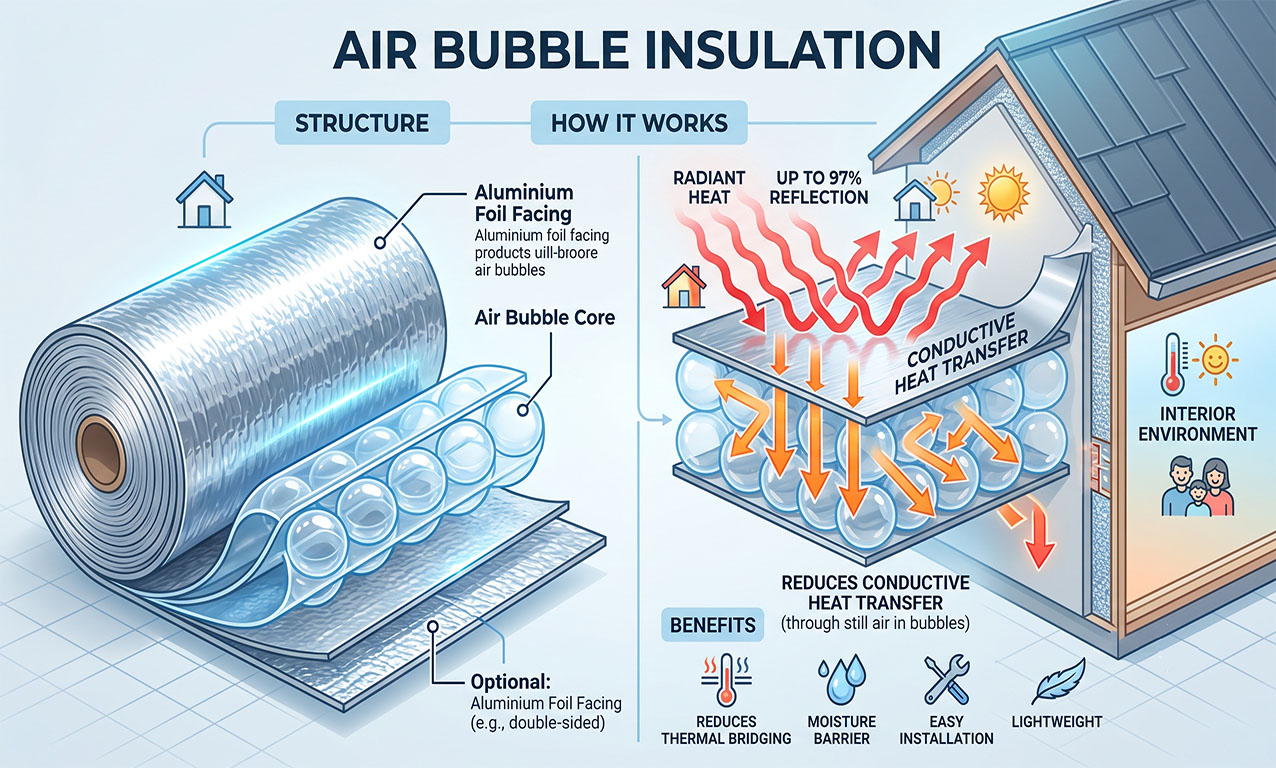
Air Bubble Insulation is a reflective insulation material consisting of aluminium foil facing on one or both sides with an air bubble core in between. The aluminium foil reflects up to 97% of radiant heat, while the air bubbles reduce conductive heat transfer .
Key Features:
High Reflectivity: Aluminium foil reflects up to 97% of radiant heat
Lightweight: Adds negligible structural load to your PEB frame
Moisture Resistant: Non-woven facing prevents condensation and corrosion
Easy Installation: Flexible and simple to handle
Thickness Range: 4mm to 20mm
Applications:
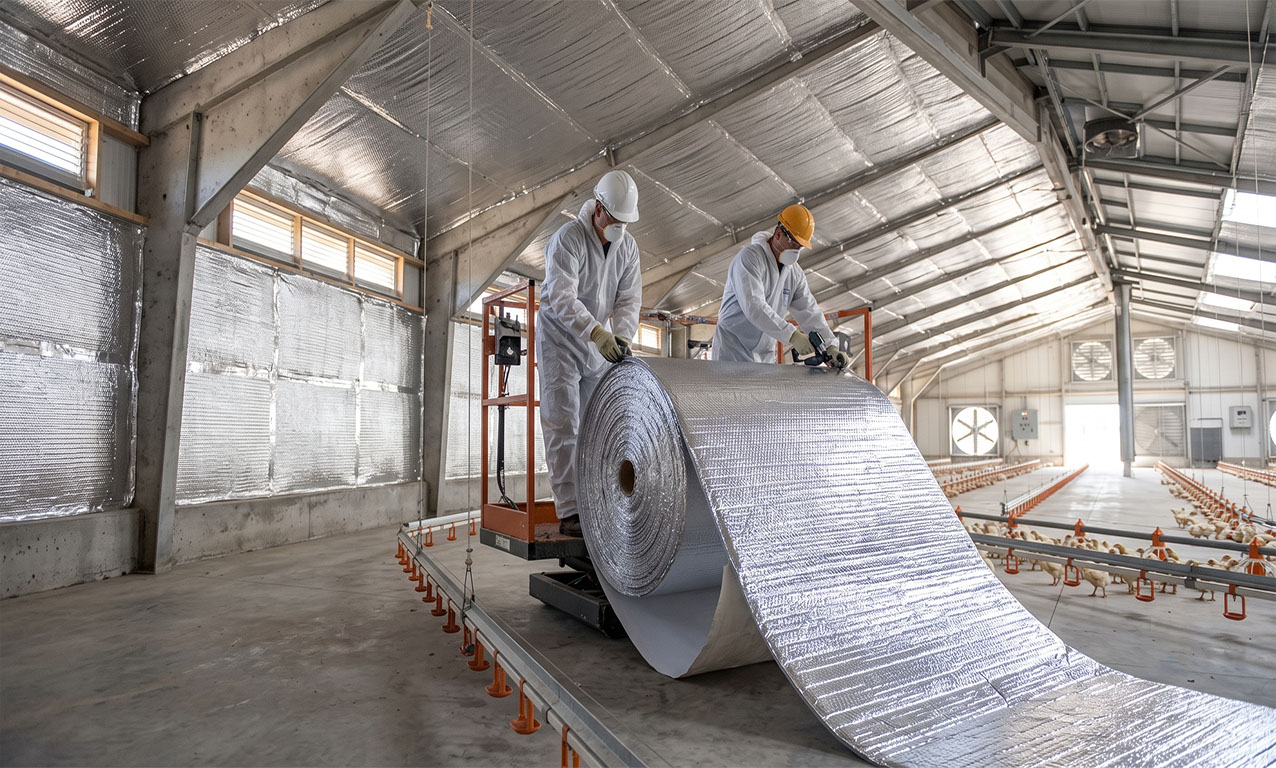
Roof insulation for PEB sheds and warehouses
Underdeck insulation for heat reduction
HVAC duct insulation
Poultry farms and greenhouses
B. XLPE Insulation
What It Is:
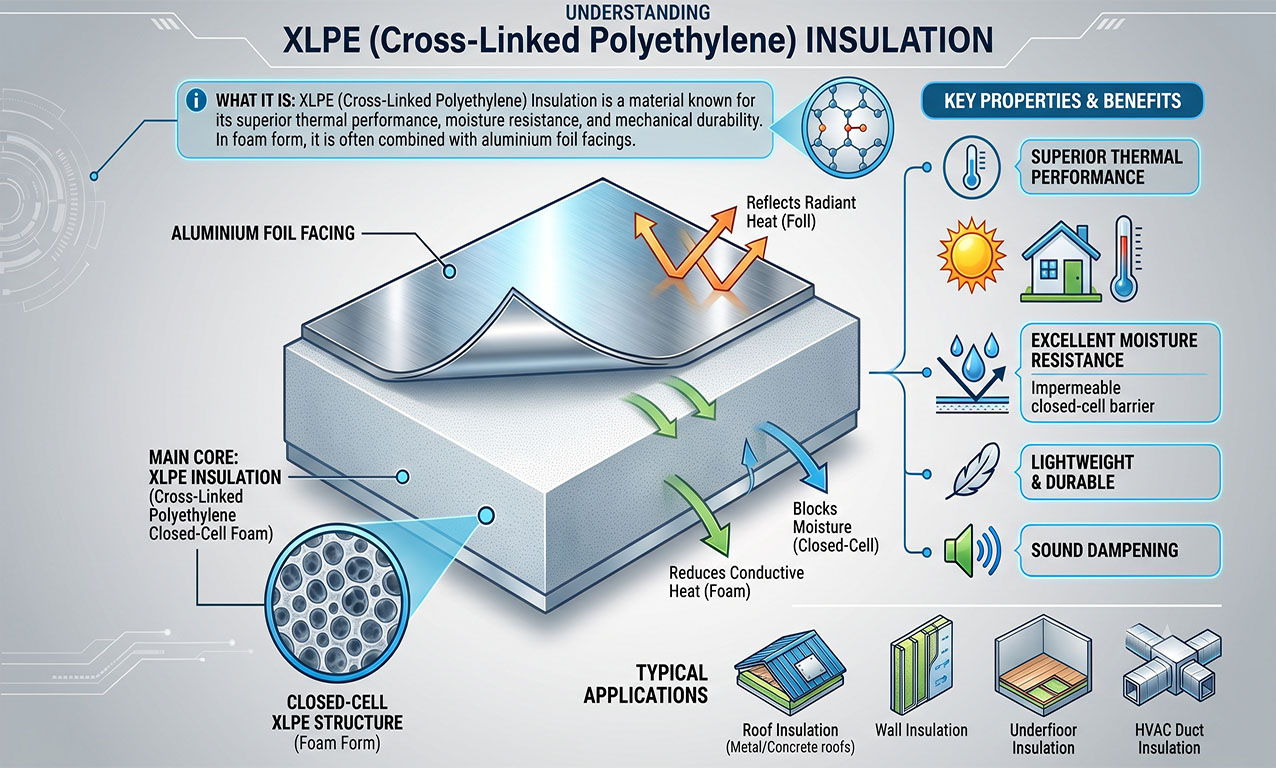
XLPE (Cross-Linked Polyethylene) Insulation is a closed-cell foam insulation material known for its superior thermal performance and moisture resistance. It is often combined with air bubble layers and aluminium foil facings for enhanced performance .
Key Features:
Closed-Cell Structure: Superior thermal performance with low thermal conductivity
High Moisture Resistance: Minimal water absorption preserves long-term efficiency
Lightweight & Flexible: Easy to install with reduced installation time
Excellent Dimensional Stability: Long service life under varying environmental conditions
Fire Resistance: XLPE provides additional fire safety
Applications:
Roof and wall insulation for PEB structures
HVAC ducting and cold storage
Clean room insulation
Poultry farms and greenhouses
C. Sandwich Panels
What They Are:
Sandwich Panels are composite construction elements with a lightweight insulating core sandwiched between two rigid face sheets (steel, aluminium, or fibre cement). They are the most widely used insulation solution for PEB structures in India .
Face Sheet Options:
Steel: 0.4–0.6 mm (industrial standard)
Aluminium: 0.8–1.0 mm (premium option)
Fibre Cement: 6–12 mm (architectural)
Standard Sizes:
Thickness: 50mm to 150mm
Width: 1000–1200 mm
Length: 3000–12000 mm
C1. Polyurethane Foam (PUF) Panels
Overview:
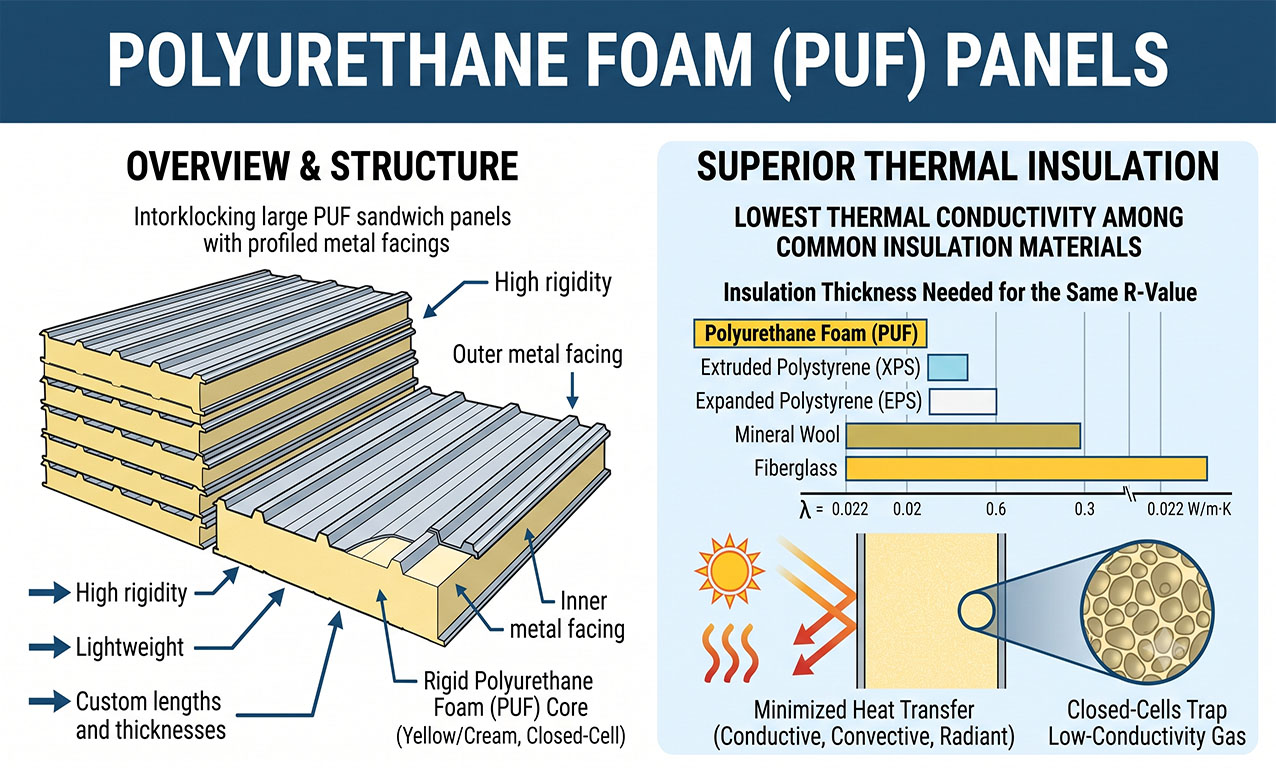
PUF panels feature a rigid polyurethane foam core with the lowest thermal conductivity among common insulation materials .
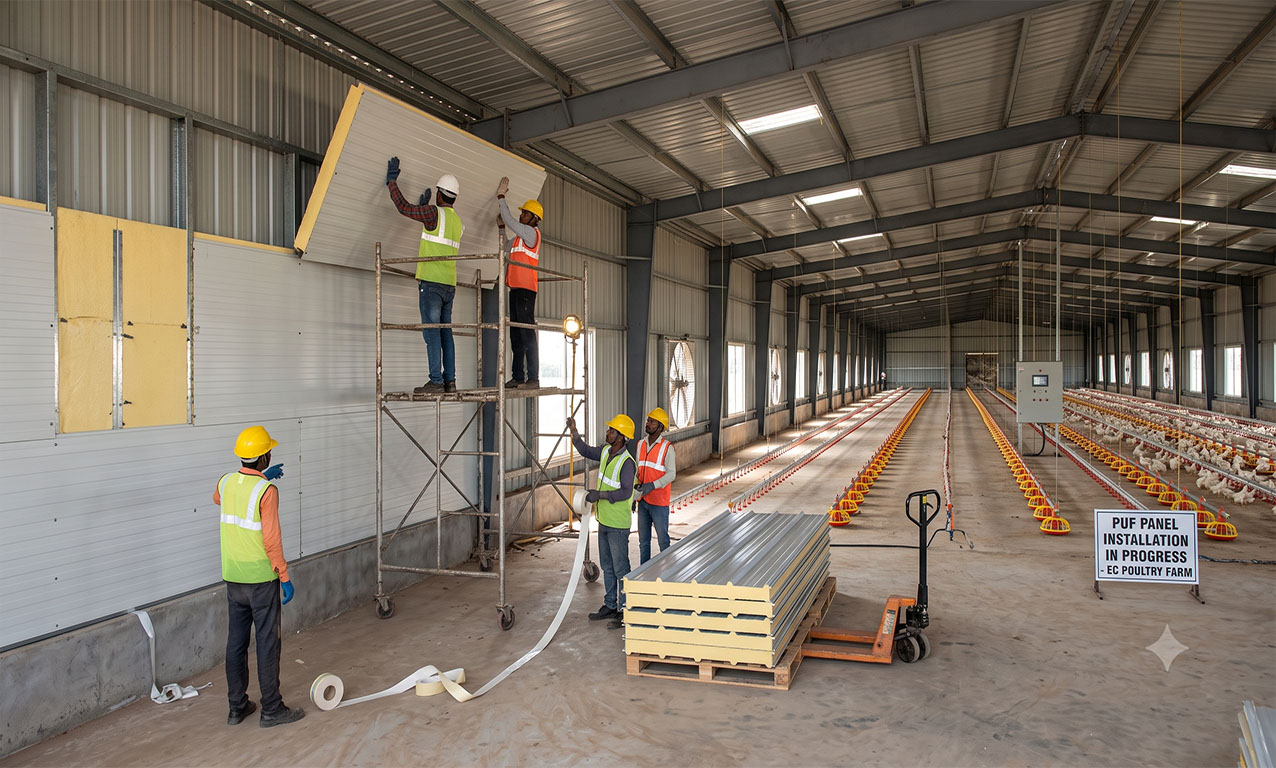
Technical Specifications :
| Parameter | Value |
|---|---|
|
Thermal Conductivity |
0.020–0.024 W/mK |
|
Density |
38–45 kg/m³ |
|
Fire Rating |
B2 (self-extinguishing), upgradable to B1 |
|
Temperature Range |
−40°C to +80°C |
|
Price Range |
₹100–₹400 per sq ft |
Best For: Cold storage, industrial roofing and cladding, warehouses, clean rooms, poultry sheds
C2. Polyisocyanurate (PIR) Panels
What They Are:
Sandwich Panels are composite construction elements with a lightweight insulating core sandwiched between two rigid face sheets (steel, aluminium, or fibre cement). They are the most widely used insulation solution for PEB structures in India .
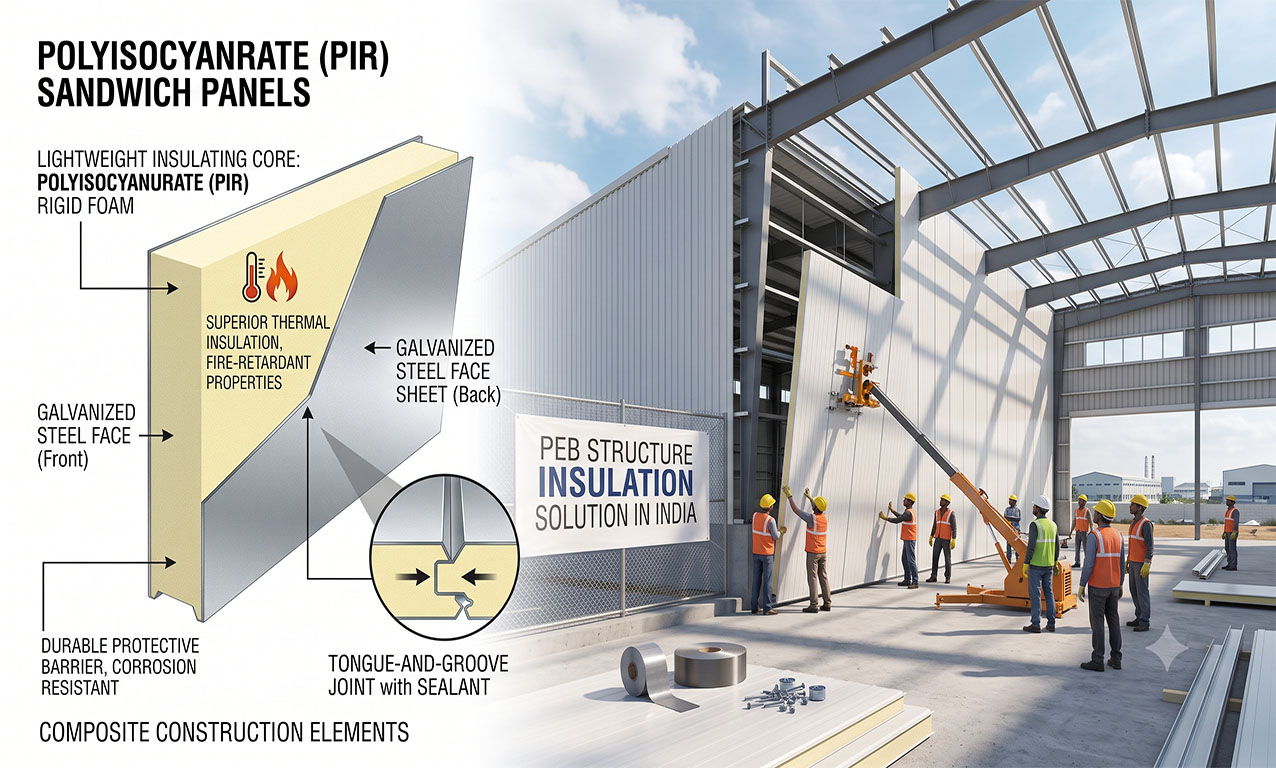
Technical Specifications :
| Parameter | Value |
|---|---|
|
Thermal Conductivity |
0.020–0.023 W/mK |
|
Density |
40–48 kg/m³ |
|
Fire Rating |
B-s1,d0 (EN 13501-1), FM 4880/4881 eligible |
|
Temperature Range |
−40°C to +120°C |
|
Price Range |
₹120–₹480 per sq ft (10–20% above PUF) |
Best For: Cold storage with insurance requirements, pharmaceutical facilities, food processing plants, data centres, and any project requiring FM approval or enhanced fire safety
C3. Rockwool / Mineral Wool Panels
What They Are:
Sandwich Panels are composite construction elements with a lightweight insulating core sandwiched between two rigid face sheets (steel, aluminium, or fibre cement). They are the most widely used insulation solution for PEB structures in India .
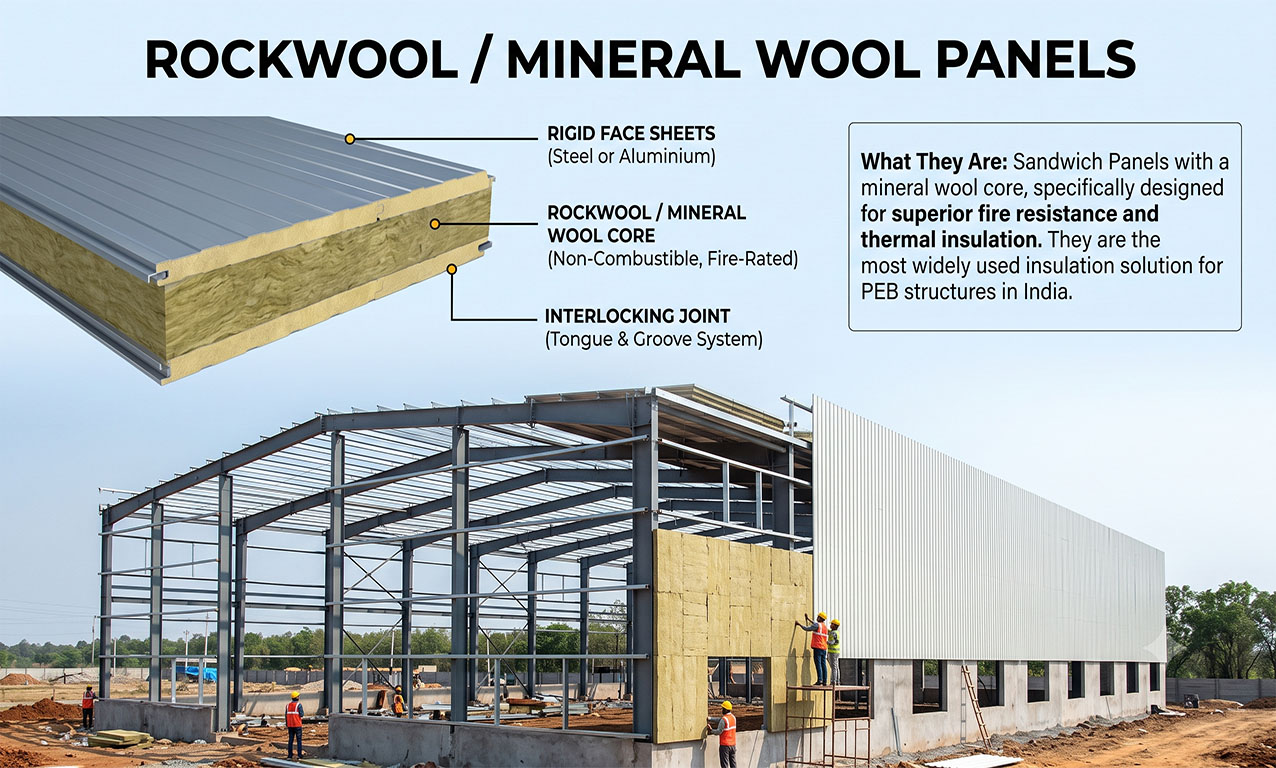
Technical Specifications :
| Parameter | Value |
|---|---|
|
Thermal Conductivity |
0.034–0.040 W/mK |
|
Density |
100–150 kg/m³ |
|
Fire Rating |
A1/A2 (non-combustible) per EN 13501-1 |
|
Acoustic Insulation |
Excellent (Rw up to 35 dB for 50mm panels) |
|
Temperature Range |
−40°C to +750°C (core material) |
|
Price Range |
₹130–₹350 per sq ft |
Best For: Fire-critical applications (fire walls, escape corridors), acoustic barriers, high-temperature environments, buildings in high-density urban areas subject to strict fire codes
C4. Expanded Polystyrene (EPS) Panels
What They Are:
Sandwich Panels are composite construction elements with a lightweight insulating core sandwiched between two rigid face sheets (steel, aluminium, or fibre cement). They are the most widely used insulation solution for PEB structures in India .
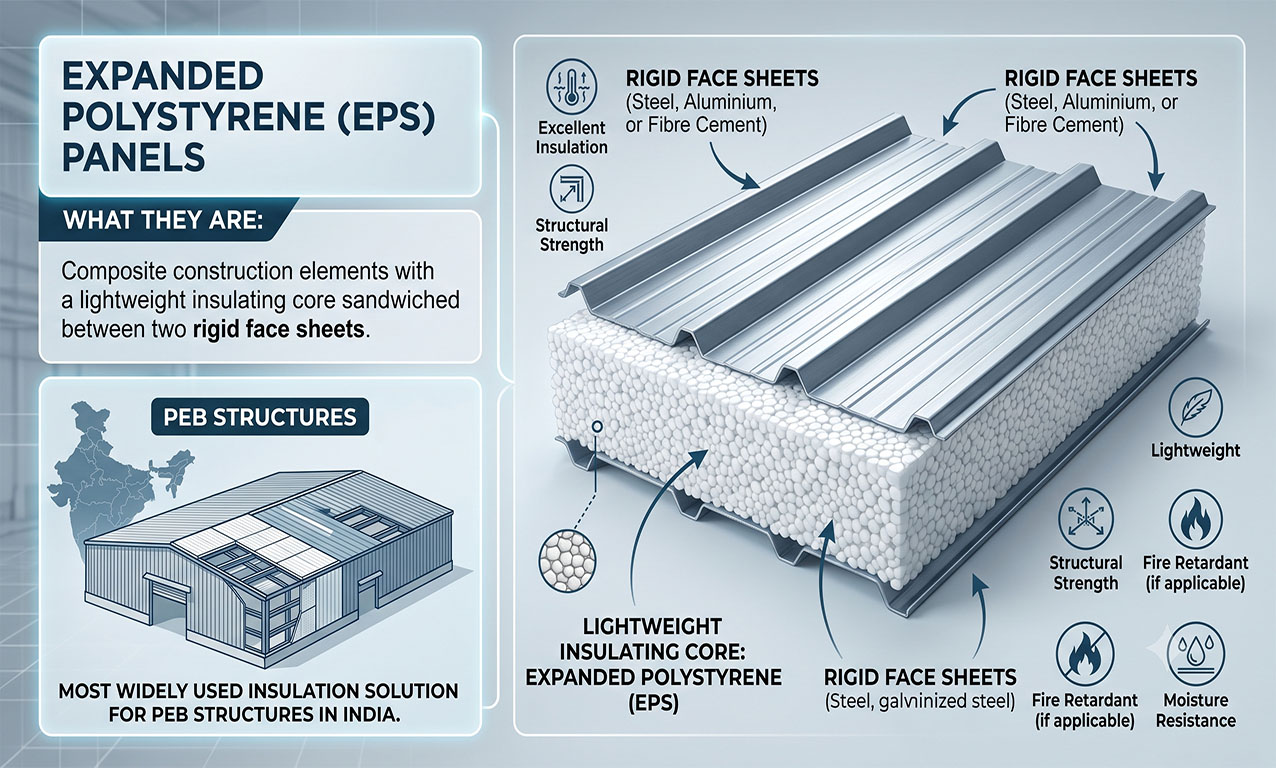
Technical Specifications :
| Parameter | Value |
|---|---|
|
Thermal Conductivity |
0.035–0.040 W/mK |
|
Density |
15–25 kg/m³ |
|
Fire Rating |
B3 (flammable); can be improved to B2 with flame-retardant grades |
|
Temperature Range |
−10°C to +75°C |
|
Price Range |
₹60–₹120 per sq ft — lowest cost option |
Best For: Non-critical partitions, temporary structures, site offices, and budget-sensitive projects where fire safety is managed through other means
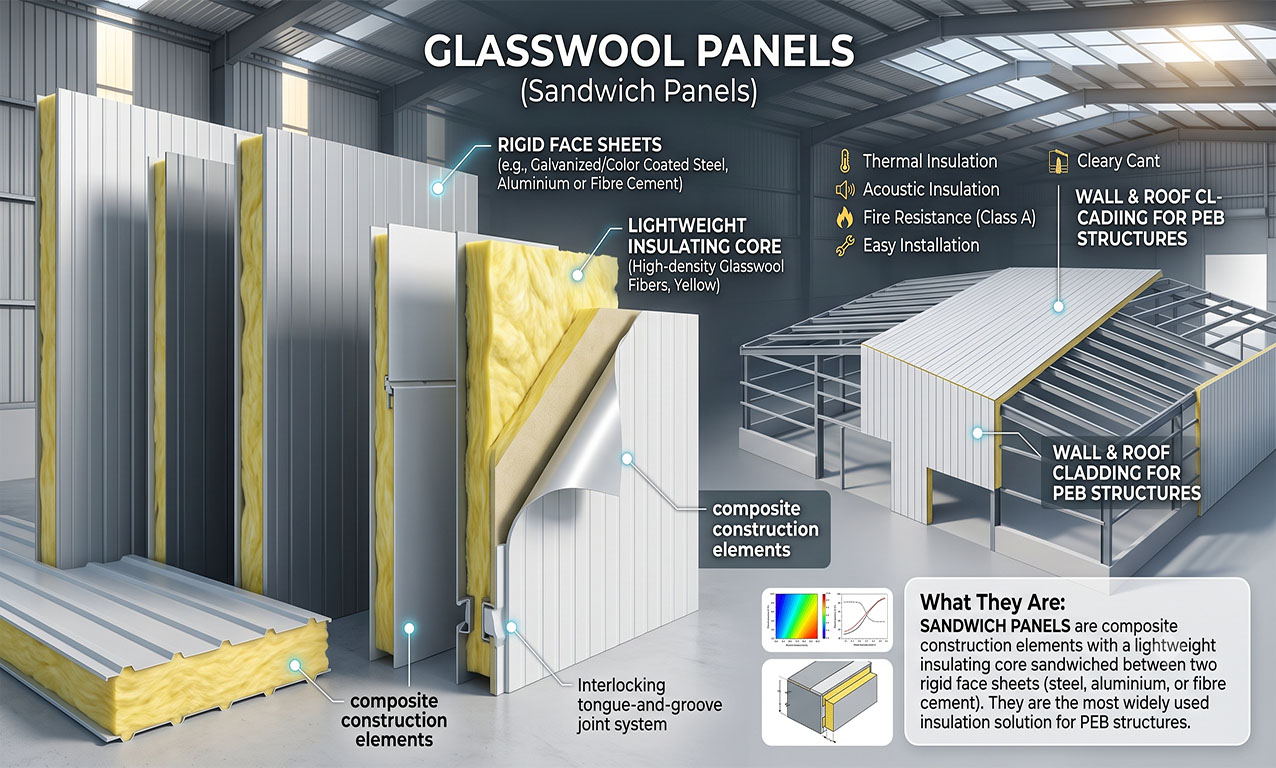
C5. Glasswool Panels
What They Are:
Sandwich Panels are composite construction elements with a lightweight insulating core sandwiched between two rigid face sheets (steel, aluminium, or fibre cement). They are the most widely used insulation solution for PEB structures in India .
Technical Specifications :
| Parameter | Value |
|---|---|
|
Thermal Conductivity |
0.032–0.040 W/mK |
|
Density |
10–24 kg/m³ (standard) |
|
Fire Rating |
Non-combustible |
|
Acoustic Insulation |
Excellent sound absorption |
|
Recommended Thickness |
50mm minimum for PEB insulation |
|
Price Range |
Economical — lower than sandwich panels |
Best For: Underdeck insulation, acoustic insulation, condensation control, PEB roofs and walls
Insulation Comparison Chart
Choosing the Right Insulation for Your PEB Structure
| Insulation Type | Thermal Conductivity (W/mK) | Fire Rating | Best For | Price Range |
|---|---|---|---|---|
|
PUF Panel |
0.020–0.024 |
B2 (self-extinguishing) |
Cold storage, warehouses |
₹100–₹400/sq ft |
|
PIR Panel |
0.020–0.023 |
B-s1,d0 |
Fire-sensitive projects |
₹120–₹480/sq ft |
|
Rockwool Panel |
0.034–0.040 |
A1/A2 (non-combustible) |
Fire walls, acoustic barriers |
₹130–₹350/sq ft |
|
EPS Panel |
0.035–0.040 |
B3 (flammable) |
Budget projects, partitions |
₹60–₹120/sq ft |
|
Glasswool |
0.032–0.040 |
Non-combustible |
Underdeck, acoustic |
Economical |
|
Air Bubble |
Reflective (radiant barrier) — Roof, underdeck Economical |
—— |
Roof, underdeck |
Economical |
|
XLPE |
Closed-cell foam |
Fire resistant |
HVAC, cold storage |
Moderate |
|
|
|
|
|
|
|
|
|
|
|
|
Which Insulation Should You Choose?
| Application | Recommended Insulation |
|---|---|
|
EC Poultry Farm |
PUF Panels (primary choice) or PIR Panels (for fire-sensitive projects) |
|
Cold Storage |
PUF or PIR Panels |
|
Fire-Rated Walls |
Rockwool Panels |
|
Industrial Roofing |
PUF, PIR, or Glasswool |
|
Budget Projects |
EPS Panels or Air Bubble |
|
Acoustic Requirements |
Rockwool or Glasswool |
|
Underdeck Insulation |
Glasswool or Air Bubble |
|
HVAC Ducts |
XLPE or Air Bubble |
|
|
|
Applications Of PEB Insulation
Where Our Insulation Solutions Are Used
Industrial Sheds: Roof and wall insulation for factories and manufacturing units
Warehouses: Thermal insulation for storage facilities
Cold Storage: PUF/PIR panels for temperature-controlled environments
EC Poultry Farms: Insulated sheds for climate-controlled poultry farming
Clean Rooms: PIR panels for pharmaceutical and food processing facilities
Commercial Buildings: Insulation for offices and showrooms
Data Centres: PIR panels for temperature-sensitive equipment
Technical Specifications
Engineered for Performance and Durability
Understanding Insulation Metrics :
| Metric | What It Measures | Good Value |
|---|---|---|
|
k-value (Thermal Conductivity) |
How easily heat passes through a material |
Lower is better |
|
R-value (Thermal Resistance) |
Insulating effectiveness of a specific thickness |
Higher is better |
|
U-value (Thermal Transmittance) |
Rate of heat transfer through complete assembly |
Lower is better |
Formula: R-value = Thickness (m) ÷ k-value (W/mK)
Example: 50mm PUF panel with k-value 0.022 has R-value = 0.05 ÷ 0.022 = 2.27 m²K/W
Recommended Performance:
Recommended thermal resistance: R > 1.25 m²°C/W
Final roof/wall composite U-value: 0.35 to 0.7 W/m²°C
Installation Guidelines
Proper Installation for Maximum Performance
Pre-Installation :
1. Verify Application: Confirm the right insulation type for your roof/wall application
2. Check Thickness: Ensure adequate thickness for your climate and requirements
3. Prepare Surface: Clean and prepare the surface before installation
Installation :
4. Correct Orientation: Install facing side toward the interior (for reflective insulation)
5. Seal Joints: Ensure proper sealing at overlaps and edges
6. Secure Fastening: Use appropriate fasteners for the insulation type
7. Avoid Compaction: Do not compress insulation during installation — this reduces R-value
Post-Installation :
8. Inspect: Check for gaps, tears, or compression
9. Vapor Retarder: Ensure vapor retarder is properly installed to control condensation
10. Maintenance: Periodic inspection for damage or moisture ingress
Ready to Build Your Industrial Shed in Odisha?
Don’t settle for subpar infrastructure. Partner with Arise PEB Construction for a structure that stands the test of time.