
EOT Crane for PEB Structures in Odisha
Move heavy loads with precision and power. Our EOT Crane Systems — including single girder and double girder configurations — are engineered to integrate seamlessly with your Pre-Engineered Building. From crane runway beams to complete installation, we deliver crane-ready structures across Odisha.
Get A Free Quotation
Introduction
Why EOT Cranes Are Essential for Modern Industrial Operations
In today’s fast-paced industrial environment, efficient material handling is not a luxury — it’s a necessity. Whether you’re moving raw materials, finished goods, or heavy equipment, the ability to lift and transport loads safely and quickly directly impacts your productivity and profitability.
An EOT (Electric Overhead Traveling) Crane — also known as a bridge crane — is the most common type of overhead crane used in industrial facilities . It consists of parallel runways with a traveling bridge spanning the gap, equipped with a hoist for lifting and lowering loads .
At Arise PEB Construction, we don’t just build PEB structures — we build crane-ready PEB structures. Our engineers design and integrate crane runway beams (gantry girders) directly into your building’s steel framework, ensuring your structure can safely support the loads and forces generated by EOT crane operations .
Whether you need a single girder EOT crane for light to medium loads or a double girder EOT crane for heavy-duty applications, we deliver complete solutions across Odisha.
What is an EOT Crane?
Understanding Electric Overhead Traveling Cranes
An EOT Crane is a type of overhead crane consisting of a horizontal bridge that runs on elevated tracks (runways) mounted on the building’s columns or runway beams . The hoist trolley travels along the bridge, and the entire bridge assembly moves along the runways — covering a rectangular area on the floor below.
Key Components of an EOT Crane :
| Component | Function |
|---|---|
|
Bridge/Girder |
The main horizontal beam that spans the width of the building |
|
Trolley/Crab |
Carries the hoist and travels along the bridge |
|
Hoist |
The lifting mechanism (wire rope or chain) |
|
End Carriages |
Support the bridge and travel along the runway rails |
|
Runway Beams |
The structural beams on which the crane travels |
|
Control System |
Pendant, radio remote, or cabin operation |
How EOT Cranes Operate:
EOT cranes can be operated in three ways :
Pendant Control: A control unit hanging from the crane, operated by a person walking alongside
Radio Remote Control: Wireless operation, giving the operator freedom to position themselves for the best view
Cabin Operation: An on-board driver sits in a cabin attached to the bridge or trolley
Types Of EOT Cranes We Offer
Single Girder & Double Girder EOT Crane Solutions
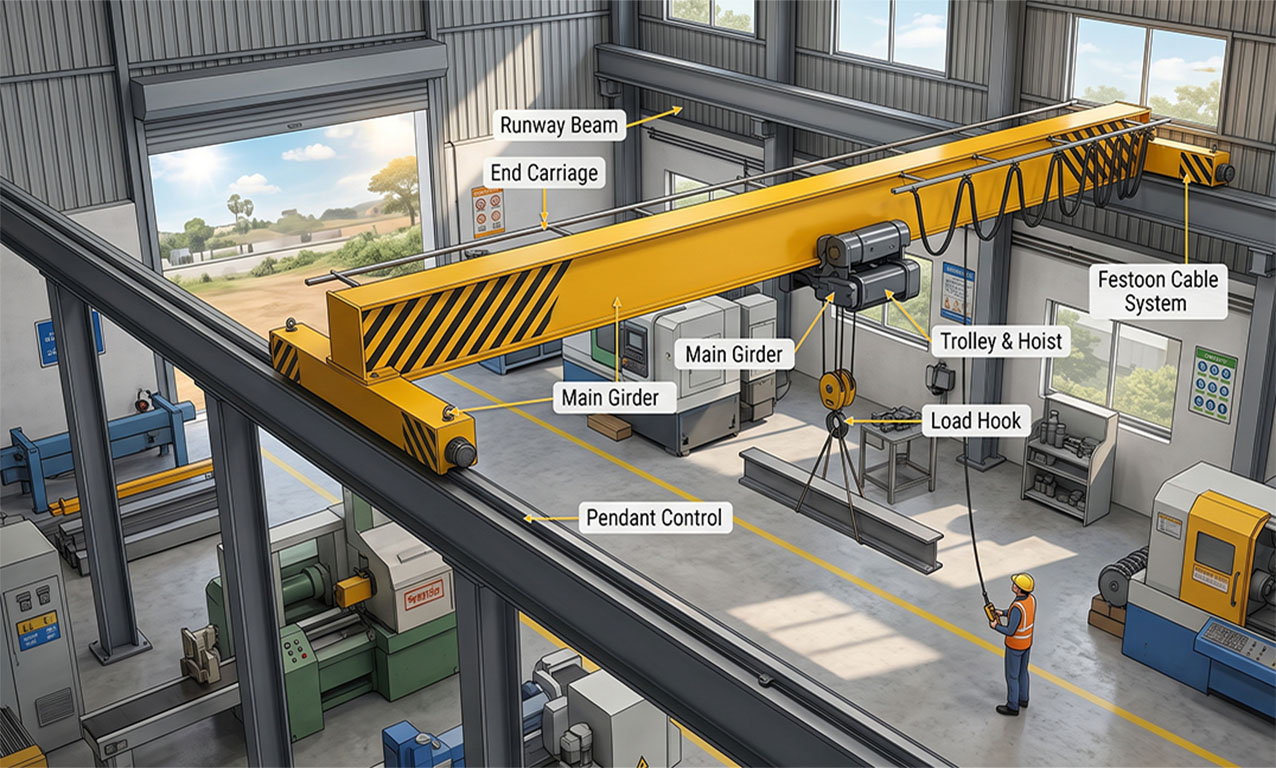
A. Single Girder EOT Crane
What It Is:
A single girder EOT crane features one main girder with a trolley and hoist running parallel to the axis . It is the most common and cost-effective type of EOT crane.
Key Features:
Simple and compact design
Easy to install and maintain
Lower dead weight
Cost-effective for light to medium loads
Available with push-button pendant or radio remote control
Applications:
Workshops and assembly lines
Warehouses and storage facilities
Light manufacturing units
Maintenance bays
| Parameter | Range |
|---|---|
|
Capacity |
1MT to 20MT |
|
Span |
Up to 30 meters |
|
Duty Class |
M3 to M5 (as per IS 3177) |
|
Hoisting Speed |
3.5 to 8 m/min |
B. Double Girder EOT Crane
What It Is:
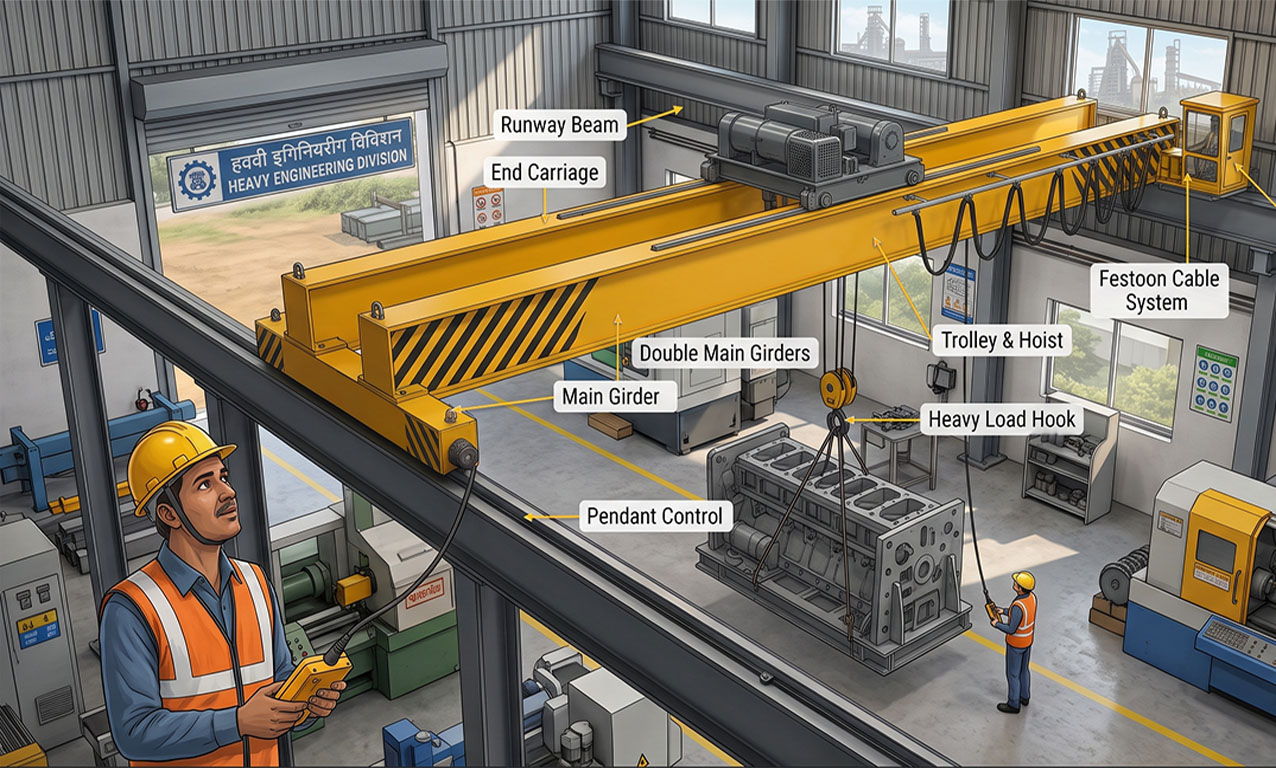
A double girder EOT crane features two main girders, providing higher load capacity and better stability . It is designed for heavy-duty industrial applications.
Key Features:
Higher load-bearing capacity
Better stability and rigidity
Higher hook lift for taller lifts
Suitable for heavy-duty and continuous operation
Available with cabin or remote control
Applications:
Heavy manufacturing plants
Steel mills and foundries
Power plants and workshops
Large warehouses with heavy loads
Specifications :
| Parameter | Range |
|---|---|
|
Capacity |
5MT to 250MT |
|
Span |
Up to 40 meters |
|
Duty Class |
M5 to M8 (as per IS 3177) |
|
Hoisting Speed |
0-5 m/min |
C. Underslung EOT Crane
What It Is:
An underslung EOT crane is mounted below the runway beams, making it ideal for buildings with limited headroom .
Key Features:
Low headroom requirement
Maximizes available lifting height
Ideal for existing buildings with height constraints
Applications:
Buildings with low ceiling height
Retrofit installations
Workshops with limited space
Crane Runway Beams & Structural Design
Engineering the Foundation for Safe Crane Operations
An EOT crane is only as good as the structure that supports it. The crane runway beam (also called gantry girder) is the critical structural element that carries the crane loads and transfers them to the building’s columns.
What We Design :
| Element | Function |
|---|---|
|
Crane Runway Beams |
Simply supported built-up sections with/without cap channels |
|
Crane Stops |
End stops to prevent crane over-travel |
|
Maintenance Platforms |
Catwalks and ladders for crane maintenance access |
|
Vertical Bracing |
Resists longitudinal thrust from crane operations |
|
Column Design |
Columns designed for crane-induced moments and forces |
Forces We Consider in Design :
| Force Type | Description Insulation |
|---|---|
|
Vertical Load |
Weight of crane + lifted load (including impact factor) |
|
Lateral Thrust |
Horizontal force perpendicular to runway (from trolley movement) |
|
Longitudinal Thrust |
Horizontal force along runway (from crane travel) |
|
Impact |
Dynamic amplification factor for crane operations |
Permissible Deflection : We design runway beams to meet IS standards for permissible deflection under crane loads.
Technical Specifications :
Engineered for Strength, Safety, and Precision
| Parameter | Specification |
|---|---|
|
Crane Capacity |
1 MT to 250 MT |
|
Span |
Up to 40 meters |
|
Duty Class |
M3 to M8 (as per IS 3177) |
|
Crane Control |
Pendant, Radio Remote, or Cabin |
|
Runway Beam Type |
Built-up sections with/without cap channels |
|
Design Standards |
IS 800, IS 807, IS 3177 |
|
Safety Features |
Anti-collision, limit switches, overload protection |
Design Standards :
IS 800:2007 – General Construction in Steel
IS 807:2006 – Design, Erection, and Testing of Cranes
IS 3177:1999 – Code of Practice for EOT Cranes
Applications Of EOT Cranes
Where Our EOT Crane Systems Are Used
Our EOT crane systems are used across a wide range of industrial applications:
Manufacturing Plants: Assembly lines, production bays, machine shops
Warehouses & Logistics: Loading/unloading, storage handling
Steel Mills & Foundries: Heavy material handling
Power Plants: Equipment installation and maintenance
Workshops: Repair and fabrication units
Railway Workshops: Heavy lifting operations
Cement & Mining: Bulk material handling
Infrastructure Projects: Construction and erection support
Safety Features :
Built for Safe and Reliable Operation
Safety is paramount in crane operations. Our EOT crane systems include :
| Safety Feature | Function |
|---|---|
|
Overload Protection |
Prevents lifting beyond safe working load |
|
Limit Switches |
Two-stage limit switches for hoist travel |
|
Anti-Collision Devices |
Prevents collision between cranes on same runway |
|
Brakes |
Fail-safe brakes for all motions |
|
Crane Stops |
End stops to prevent over-travel |
|
Load Testing |
Cranes load tested to 125% of rated capacity |
Design Standards :
IS 800:2007 – General Construction in Steel
IS 807:2006 – Design, Erection, and Testing of Cranes
IS 3177:1999 – Code of Practice for EOT Cranes
Frequently Asked Questions About EOT Cranes
An EOT (Electric Overhead Traveling) Crane is a type of overhead crane consisting of a horizontal bridge that runs on elevated tracks (runways) mounted on the building’s columns or runway beams. The hoist trolley travels along the bridge, and the entire bridge assembly moves along the runways, covering a rectangular area on the floor below.
A single girder EOT crane has one main girder and is used for light to medium loads (1-20T). A double girder EOT crane has two main girders and is designed for heavy-duty applications (5-250T), offering higher load capacity, better stability, and higher hook lift.
A crane runway beam (also called gantry girder) is the structural beam on which the EOT crane travels. It carries the crane loads and transfers them to the building’s columns. These are typically simply supported built-up sections with or without cap channels.
EOT cranes generate four main forces on the supporting structure :
Vertical Load: Weight of crane + lifted load (with impact)
Lateral Thrust: Horizontal force perpendicular to runway
Longitudinal Thrust: Horizontal force along runway
Impact: Dynamic amplification factor
We handle EOT crane capacities from 1 MT to 250 MT. PEB buildings can be designed for crane capacities ranging from 1MT to 250MT.
EOT cranes can be operated in three ways :
Pendant Control: Control unit hanging from the crane
Radio Remote Control: Wireless operation
Cabin Operation: On-board driver in a cabin
Our EOT cranes include overload protection, two-stage limit switches, anti-collision devices, fail-safe brakes, crane stops, and load testing to 125% of rated capacity.
Duty class indicates the crane’s working frequency and load spectrum. Common duty classes include M3 (light), M5 (medium), M7 (heavy), and M8 (extra heavy) as per IS 3177.
Yes. We design crane-ready PEB structures with integrated runway beams, crane stops, maintenance platforms, and appropriate bracing to safely support EOT crane operations. Our engineers calculate all crane-induced forces and design the structure accordingly.
Ready to Build Your Industrial Shed in Odisha?
Don’t settle for subpar infrastructure. Partner with Arise PEB Construction for a structure that stands the test of time.