
Anchor Bolts for PEB Structures
J-Bolts, L-Bolts, Plate Anchors & Foundation Bolts for Every Application
Get A Free Quotation
Introduction
The Silent Guardian of Your PEB Structure
Every Pre-Engineered Building (PEB) stands on a foundation. But what connects the steel structure to that foundation? The answer is Anchor Bolts.
These critical components — also called Foundation Bolts or Holding Down Bolts (HDB) — are embedded in concrete to anchor steel columns, equipment base plates, and structural members to the foundation . They transfer tension, shear, and uplift forces from the structure to the concrete, ensuring stability against wind, seismic activity, and operational loads.
At Arise PEB Construction, we manufacture and supply Anchor Bolts for PEB Structures in Odisha — engineered to IS 5624:1993 standards and delivered with precision for your project. Whether you need J-Bolts for standard column bases or Plate Anchors for high-uplift conditions, we have the right solution.
What Is An Anchor Bolt?
Understanding Anchor Bolts (Foundation Bolts / Holding Down Bolts)
An Anchor Bolt is a steel bolt embedded in concrete to connect a steel structural member or equipment base plate to the foundation . It is also known as:
Foundation Bolt
Holding Down Bolt (HDB)
J-Bolt (based on shape)
L-Bolt (based on shape)
Function of Anchor Bolts:
Anchor bolts serve three critical functions:
Tension Transfer: They resist uplift forces caused by wind, seismic activity, and equipment vibration — preventing the structure from being pulled off its foundation.
Shear Transfer: They resist lateral forces that try to slide the structure horizontally across the foundation.
Structural Integrity: They ensure the steel column and concrete foundation act as a single, integrated unit — distributing loads safely and efficiently.
Why Anchor Bolts Are Critical:
Without properly designed and installed anchor bolts, even the strongest steel structure can fail. During high winds or seismic events, anchor bolts are the first line of defense — preventing column base rotation, uplift, and structural collapse.
Types Of Anchor Bolts We Offer
J-Bolts, L-Bolts, Plate Anchors & More
We manufacture and supply the complete range of anchor bolts for every PEB application:
A. J-Bolt (J-Type Anchor Bolt)
The J-Bolt is the most common type of anchor bolt, featuring a straight shank with a 180° bend at the bottom. The bent end provides mechanical anchorage in concrete — preventing the bolt from pulling out under tension.
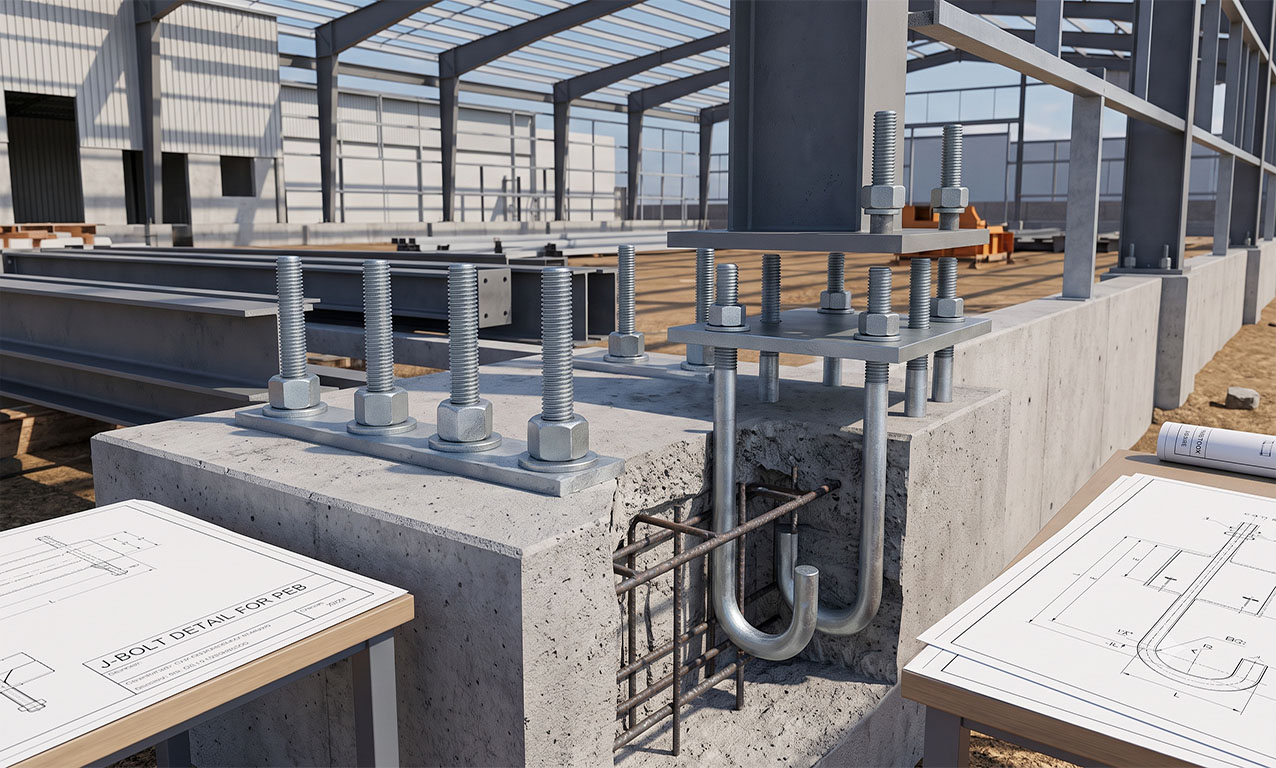
Key Features:
180° bend at bottom for mechanical anchorage
Bent length typically 4-6 times the shank diameter
Simple and cost-effective
Ideal for cast-in-place installation
Applications:
PEB column base plates
Equipment foundations
Machine bases
Structural steel anchorage
Specifications:
Diameter : M16 to M36 (custom sizes available)
Length : 300mm to 1500mm
Material Grade : IS 2062 / Grade 4.6 (FY=250 MPa)
Standard : IS 5624:1993
B. L-Bolt (L-Type Anchor Bolt)
The L-Bolt features a straight shank with a 90° bend at the bottom. It is used where headroom is limited — the 90° bend requires less vertical space than the 180° bend of a J-Bolt.
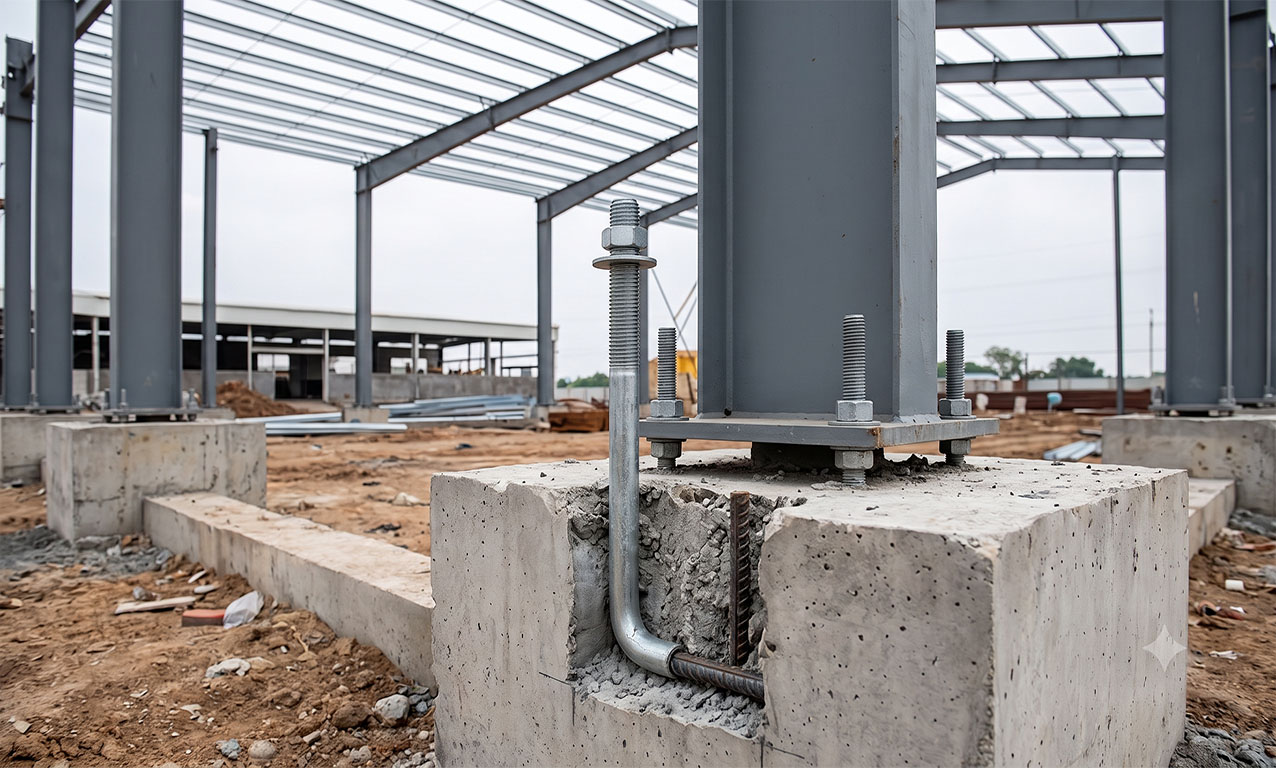
Key Features:
90° bend at bottom for anchorage
Bend length typically 4-6 times the shank diameter
Suitable for limited headroom conditions
Ideal for cast-in-place installation
Applications:
PEB column bases in confined spaces
Equipment foundations
Structural steel anchorage
Retaining wall connections
Specifications:
Diameter : M16 to M36
Length : 300mm to 1200mm
Material Grade : IS 2062 / Grade 4.6
Standard : IS 5624:1993
C. Plate Anchor Bolt
The Plate Anchor Bolt features a straight shank with a square or circular plate at the bottom. The plate provides a larger bearing area — making it ideal for high-uplift conditions where standard J-Bolts and L-Bolts would pull out.
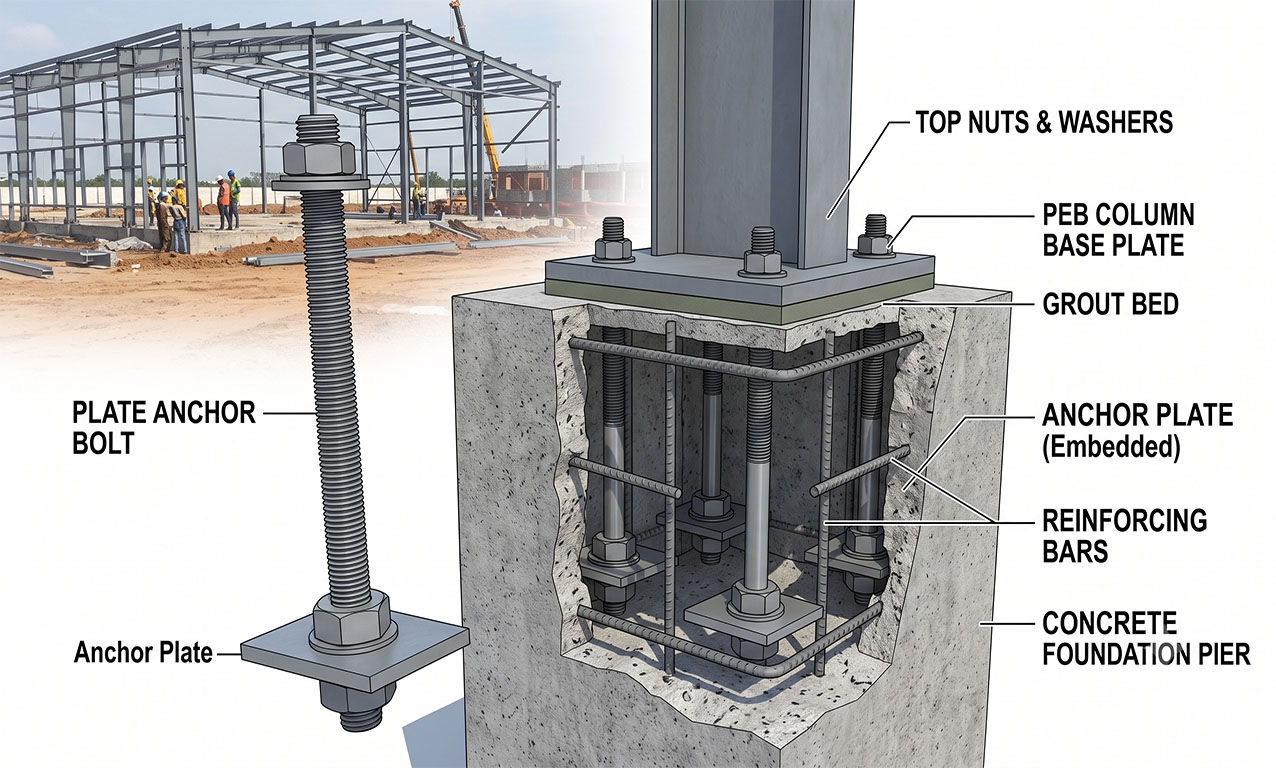
Key Features:
Square or circular plate at bottom
Large bearing area for high-uplift resistance
Superior pull-out capacity
Ideal for heavily loaded structures
Applications:
High-uplift PEB structures
Crane runway beam supports
Heavy equipment foundations
Tower and mast foundations
Specifications:
Diameter : M20 to M42
Length : 400mm to 2000mm
Plate Size : 100x100mm to 300x300mm
Material Grade : IS 2062 / Grade 4.6 / 8.8
D. Through-Bolt
The Through-Bolt passes through the entire foundation slab and is anchored by a nut on the bottom face. It is used in pile caps and large foundations where through-anchorage is required.
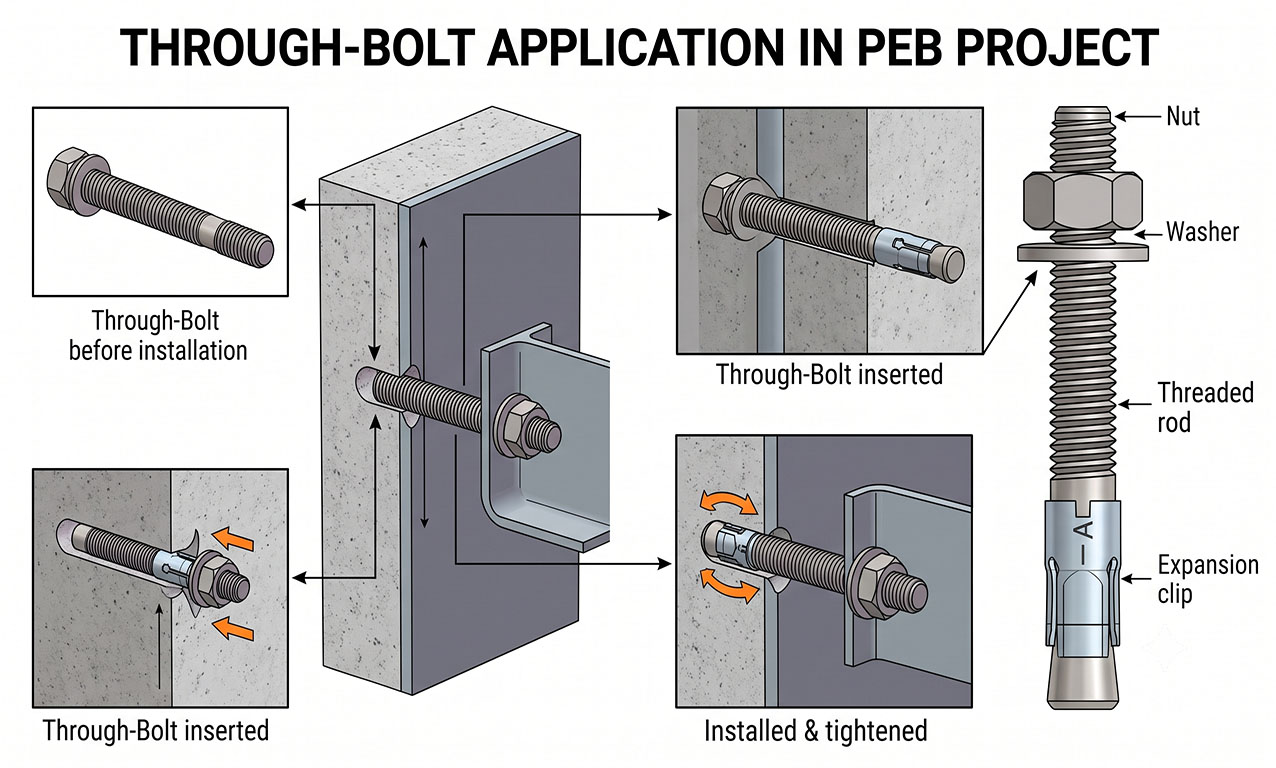
Key Features:
Passes through entire foundation slab
Nut on bottom face for anchorage
Superior tension capacity
Ideal for large foundations
Applications:
Pile caps
Large equipment foundations
Bridge bearings
Heavy structural connections
E. Chemical Anchor Bolt (Post-Installed)
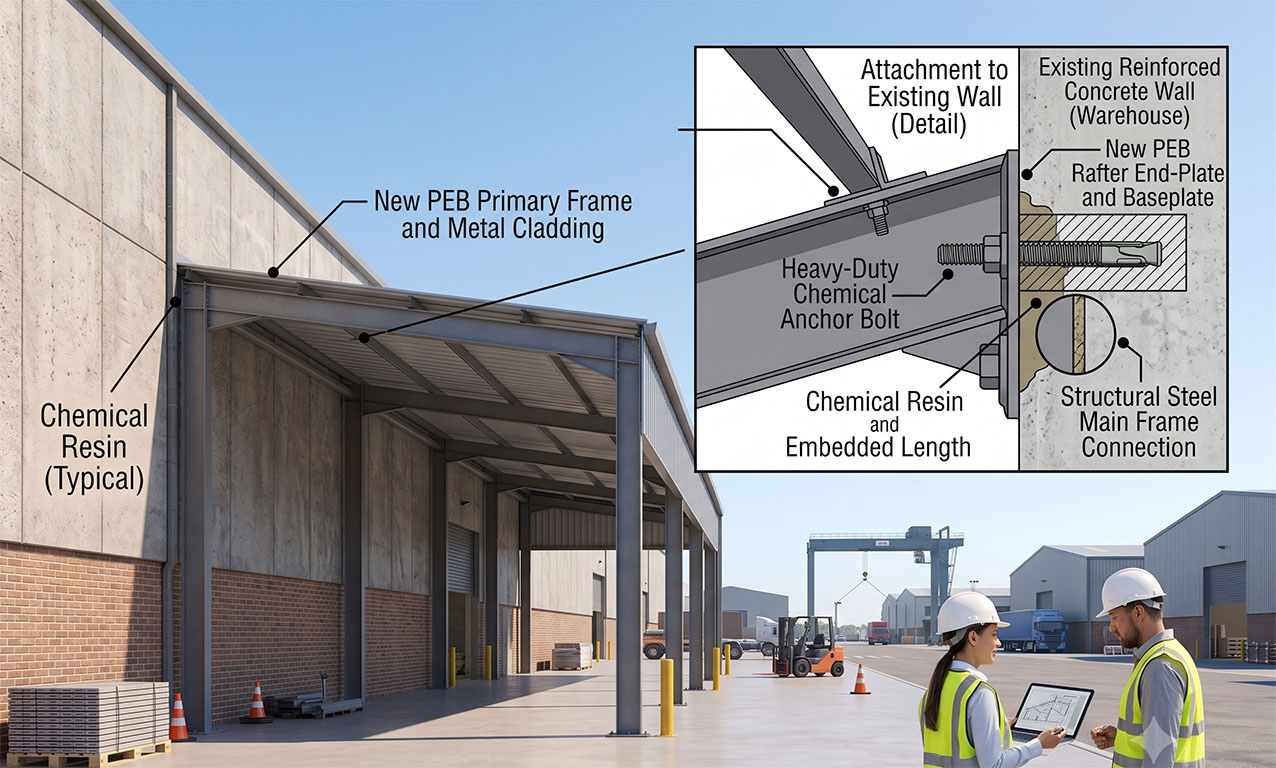
Chemical Anchor Bolts are post-installed anchors that use resin or adhesive to bond the bolt to the concrete. They are used where cast-in-place anchor bolts cannot be installed — such as retrofit projects or where bolt positions were missed during casting.
Key Features:
Post-installed (after concrete curing)
High bond strength
Suitable for retrofit and repair
No need for templates during casting
Applications:
Retrofit projects
Anchor bolt misalignment correction
Equipment installation on existing concrete
Repair and strengthening work
Specifications:
Diameter : M8 to M30
Embedment : As per manufacturer recommendations
Material Grade : SS 304 / SS 316 / High-strength steel
Technical Specifications
Engineered for Strength, Durability, and Precision
| Parameter | Specification |
|---|---|
|
Bolt Diameter |
M16, M20, M24, M30, M36 (custom sizes available) |
|
Material Grade |
IS 2062 / Grade 4.6 (FY=250 MPa) / Grade 8.8 |
|
Standard |
IS 5624:1993 (Foundation Bolts) |
|
Embedment Depth |
12d minimum for J-Bolts (e.g., M20 = 240mm) |
|
Bend Length (J/L-Bolt) |
4d minimum, typically 6d |
|
Hole Oversize |
+2mm of bolt diameter |
|
Concrete Cover |
≥ 50mm |
|
Edge Distance |
≥ 1.5 × effective embedment depth |
|
Corrosion Protection |
Galvanized / Zinc-plated / Painted / Stainless Steel |
Design Standards:
- IS 5624:1993 – Foundation Bolts – Specifications
- IS 800:2007 – General Construction in Steel (Cl. 10.4)
- IS 2062 – Hot Rolled Structural Steel
- IS 1367 – General Fasteners
Applications Of Anchor Bolts
Where Our Anchor Bolts Are Used
Our anchor bolts are used across a wide range of structures and applications:
PEB Column Base Plates: Anchoring steel columns to RCC pedestals and footings
Industrial Sheds: Column base anchorage for factories and manufacturing units
Warehouses: Large-span structures requiring reliable foundation connections
Multi-Storied Steel Buildings: Heavy-duty anchorage for multi-level structures
EC Poultry Farms: Anchorage for insulated shed frames
Crane Runway Supports: Heavy-duty anchor bolts for EOT crane beams
Equipment Foundations: Pumps, compressors, generators, and transformers
Telecom Towers: High-uplift anchorage for towers and masts
Bridge Bearings: Anchorage for bridge support structures
Solar Structures: Ground-mounted solar panel foundations
Installation Guidelines
Proper Installation for Maximum Performance
Pre-Installation (Cast-in-Place)
1. Template Preparation : Use a rigid steel or wooden template to hold anchor bolts in exact position during concrete pouring. Per IS 5624 Cl. 5, the template must be rigid, levelled, and surveyed before concrete is placed.
2. Positioning : Place the template with anchor bolts at the correct elevation and alignment. Verify against structural drawings.
3. Securing : Securely fasten the template to formwork to prevent movement during concrete pouring.
4. Verification : Survey bolt positions before pouring concrete. Misalignment of 10-25mm is common without a template — requiring oversized base plate holes that compromise design assumptions .
During Concrete Pouring
5. Careful Pouring : Pour concrete carefully around anchor bolts — avoiding direct impact that could displace them.
6. Vibration : Use concrete vibrators carefully — not directly on the anchor bolts.
7. Post-Pour Check : Verify bolt positions immediately after pouring while concrete is still workable.
Post-Installation
8. Thread Protection : After concrete curing, protect threads with grease and screw on nuts .
9. Alignment Check : Verify bolt projection and alignment. If misaligned, consider oversized holes or chemical anchors for correction.
10. Tightening : Tighten anchor bolts to the specified torque after base plate installation.
Ready to Build Your Industrial Shed in Odisha?
Don’t settle for subpar infrastructure. Partner with Arise PEB Construction for a structure that stands the test of time.